Causes and Countermeasures for Increased Conductivity of Permeate Water
发布时间:2026-07-06 分类:Industry News 浏览量:179
The rise in conductivity of reverse osmosis (RO) permeate water stems from various working conditions, equipment and water quality factors, making it difficult to directly identify the root cause. Below is a summary of all causes and corresponding solutions.
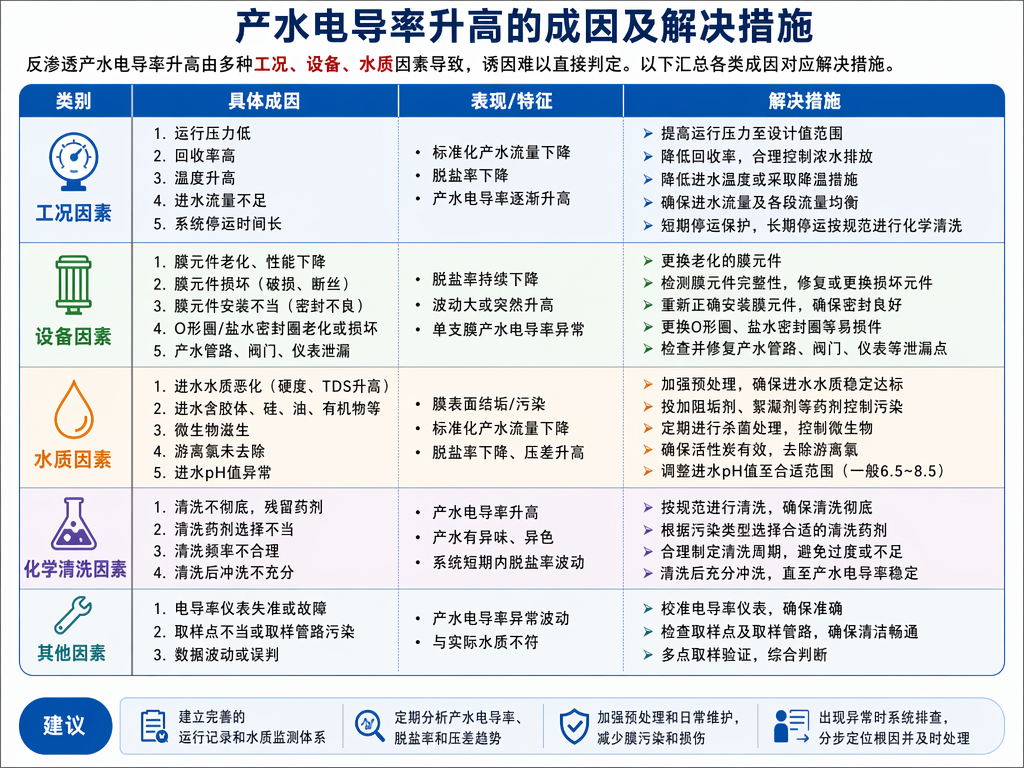
| No. | Causes of Increased Conductivity | Corresponding Countermeasures |
| 1 | Raw water contains abundant free CO₂ and other gases, which carry salts through membrane elements | Adopt professional processes to effectively remove free gases from raw water and prevent salt penetration driven by gases |
| 2 | Rising feed water temperature accelerates salt passage through membrane elements | For systems equipped with heat exchangers, appropriately lower the feed water temperature |
| 3 | Excessively high conductivity of feed water, or errors in conductivity detectors | Recycle finished permeate water to raw water to reduce salt content of incoming feed water; calibrate conductivity detectors on a regular basis |
| 4 | Abnormal feed water pH value reduces the salt rejection rate of membrane elements | Precisely adjust feed water pH: add an appropriate amount of acid for primary RO systems, and add an appropriate amount of alkali for secondary RO systems |
| 5 | Excessively low operating pressure of equipment | Raise the operating pressure to optimize the system operating status |
| 6 | Ultra-high operating pressure drastically increases salt passage rate | Standardize equipment operating parameters, avoid ultra-high pressure operation, and maintain stable operating pressure |
| 7 | Scaling and fouling of the system, mainly caused by excessive recovery rate, deteriorated raw water quality, inferior scale inhibitors, and non-standard dosing of scale inhibitors | Appropriately reduce the system recovery rate, optimize permeate water quality, select qualified scale inhibitors, and standardize chemical dosing procedures |
| 8 | Leakage at equipment connections, including leakage from damaged O-rings and poor sealing of pipelines and connectors | Conduct comprehensive maintenance inspection, locate leakage points and repair them promptly |
| 9 | Abnormally elevated system recovery rate, mostly resulting from operational errors, instrument errors and poor sealing of brine gaskets | Standardize equipment operation procedures, calibrate measuring instruments regularly, replace failed brine gaskets, and reasonably control the recovery rate |
| 10 | Over-aged membrane elements with degraded performance, scratches, oxidative corrosion or damage from chemical cleaning | Replace damaged and aged membrane elements |
| 11 | Organic fouling on membrane elements, including bacterial fouling, colloidal fouling and fouling from insoluble natural organic matter (NOM) | Perform chemical cleaning on membrane elements to thoroughly remove contaminants on membrane surfaces |