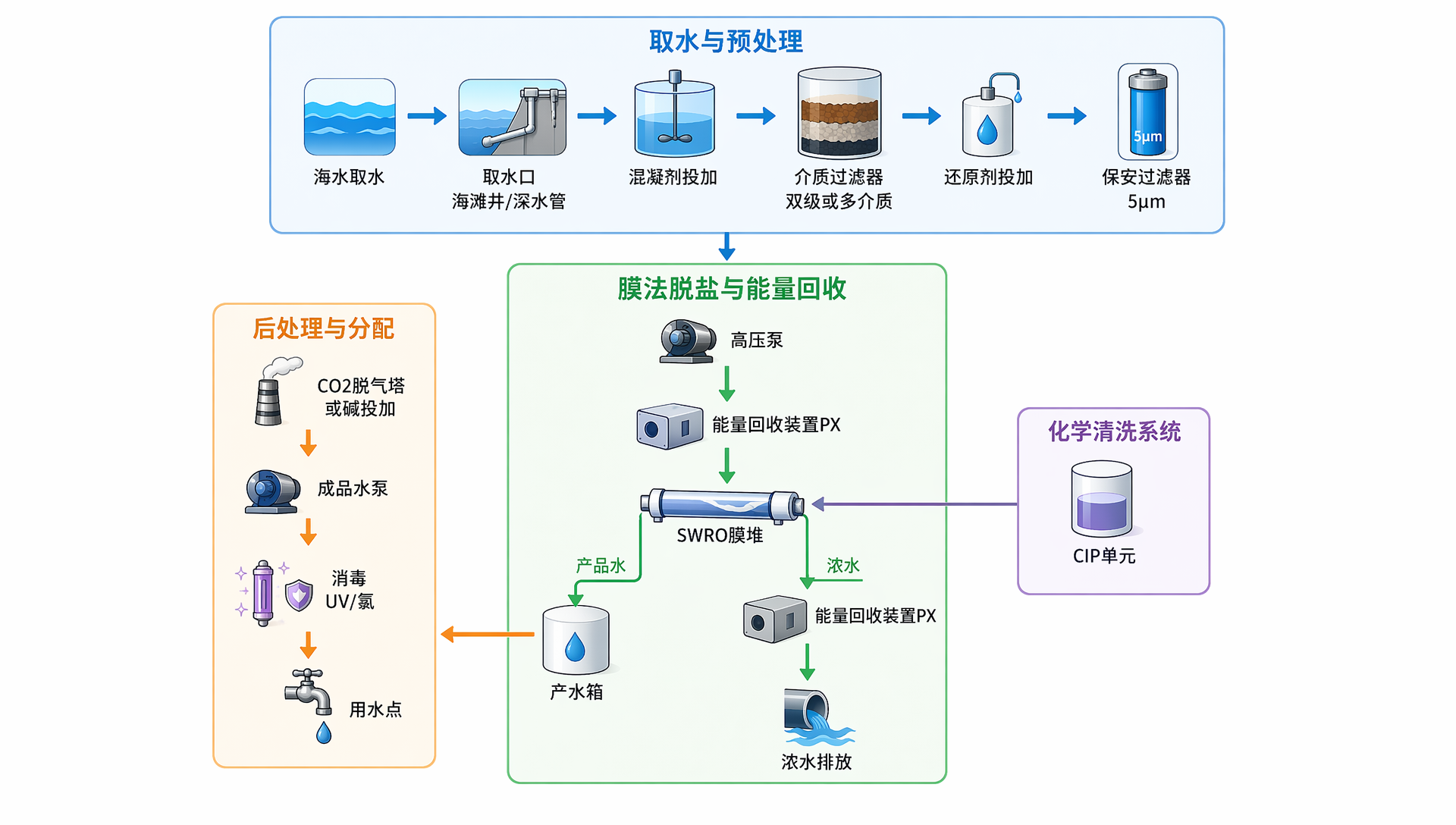
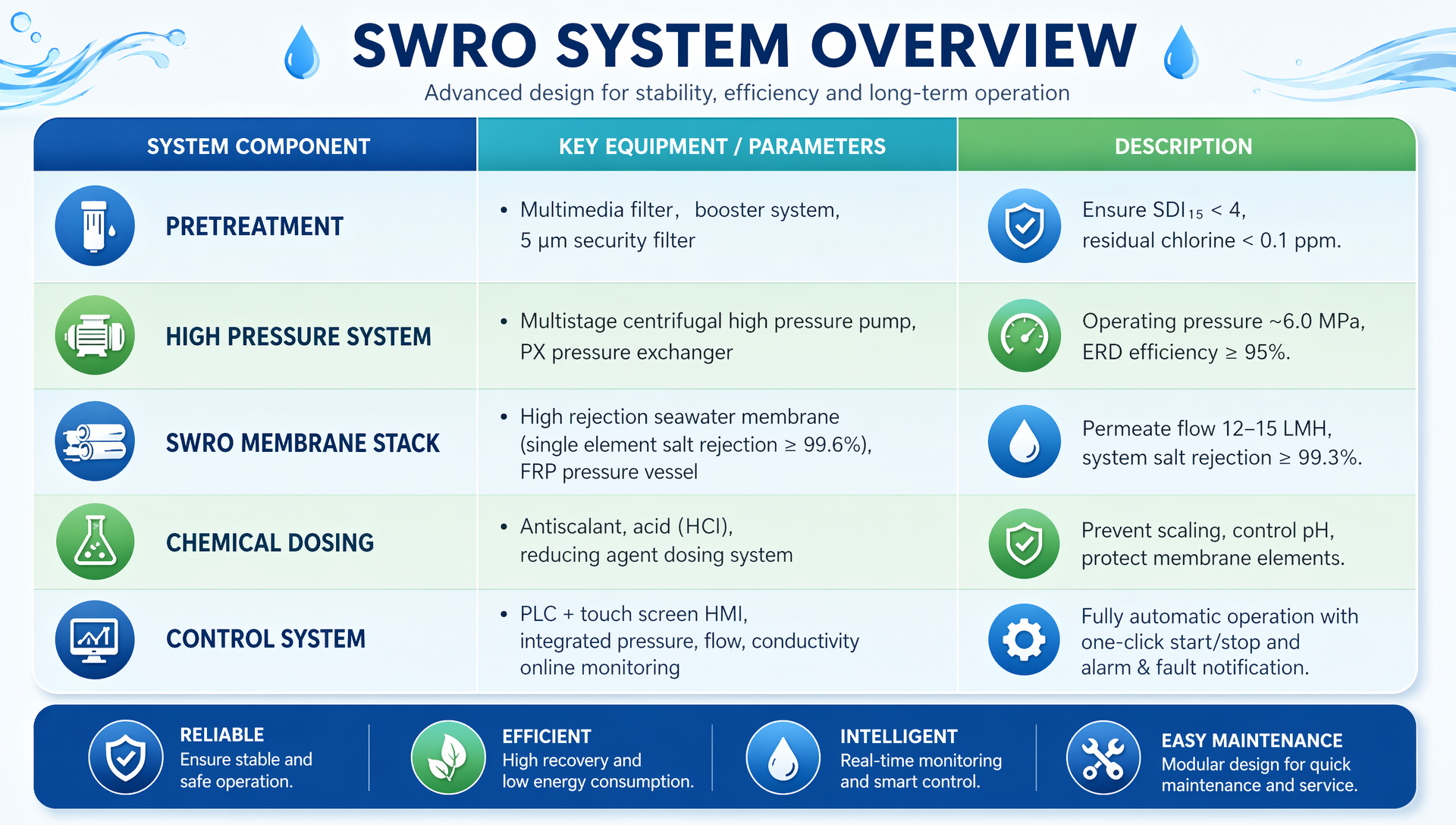
The following figure clearly illustrates the entire process from water intake to water production in a small seawater desalination plant, especially the characteristics of energy recovery and modular design..
Step by step explanation of the process:
- Water intake and pretreatment system (reliability cornerstone)
Water intake: Beach wells are preferred for water intake. Groundwater is naturally filtered through sand layers, resulting in stable water quality with low suspended solids and organic matter content. This greatly simplifies the pretreatment process and reduces the risk of biological pollution. If seawater is directly used, more complex grids and screens need to be installed.
Preprocessing: Addition of coagulants: Add coagulants (such as FeCl ∝) to destabilize small colloidal particles for subsequent filtration and removal. Media filtration: Adopting dual media filters (smokeless coal+quartz sand) or dual stage filters (primary coarse filtration, secondary fine filtration), effectively reducing turbidity and controlling pollution index (SDI ₁₅<4). Addition of reducing agent: If seawater contains residual chlorine (if seawater sterilization is used), sodium bisulfite (NaHSO3) should be added for neutralization to protect the SWRO membrane. Security filtration: A 5 μ m precision filter serves as the final safety barrier before the SWRO membrane.
- High pressure pumping and energy recovery (energy efficiency core)
High pressure pump: Raise the pre treated seawater to the operating pressure required by the SWRO membrane (approximately 5.5-6.5 MPa).
Energy Recovery Device (ERD): This is the key to the economic feasibility of small-scale seawater desalination systems. By using a pressure exchange (PX) energy recovery device, more than 95% of the energy in high-pressure concentrated water (about 5.5-6.0 MPa) is directly transferred to a portion of the feed seawater, which can reduce the total energy consumption of the system by 35-40%. This reduces the energy consumption per ton of water for small-scale seawater desalination to 3.0-4.5 kWh/m ³.
- Reverse osmosis desalination (core process unit)
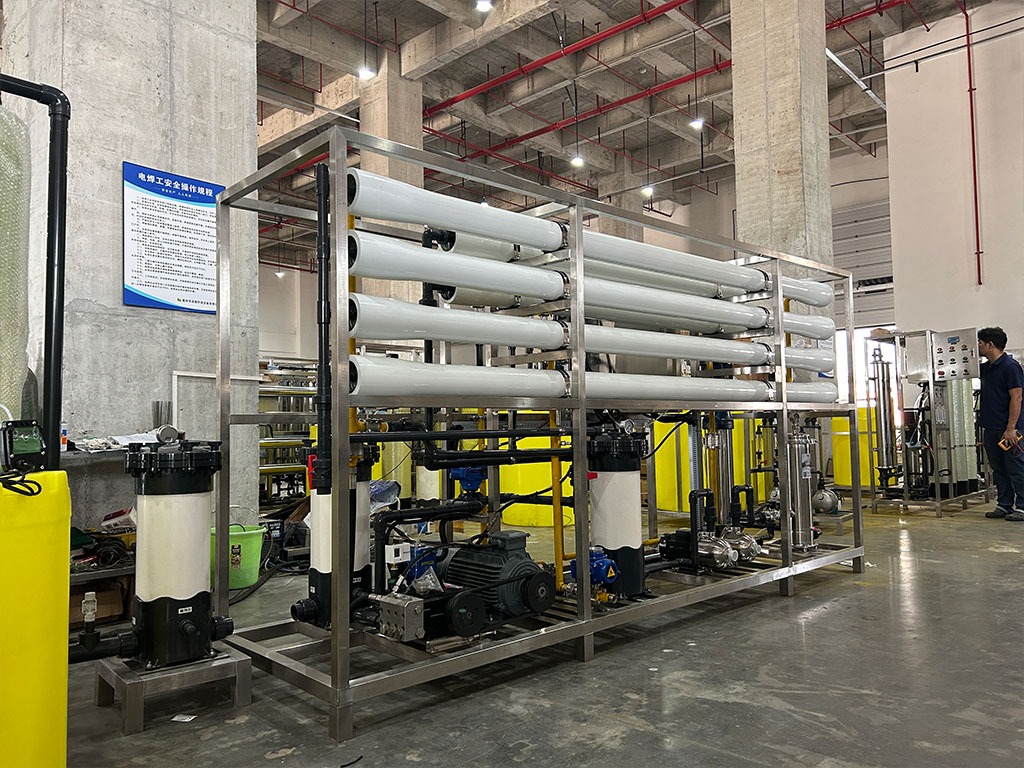
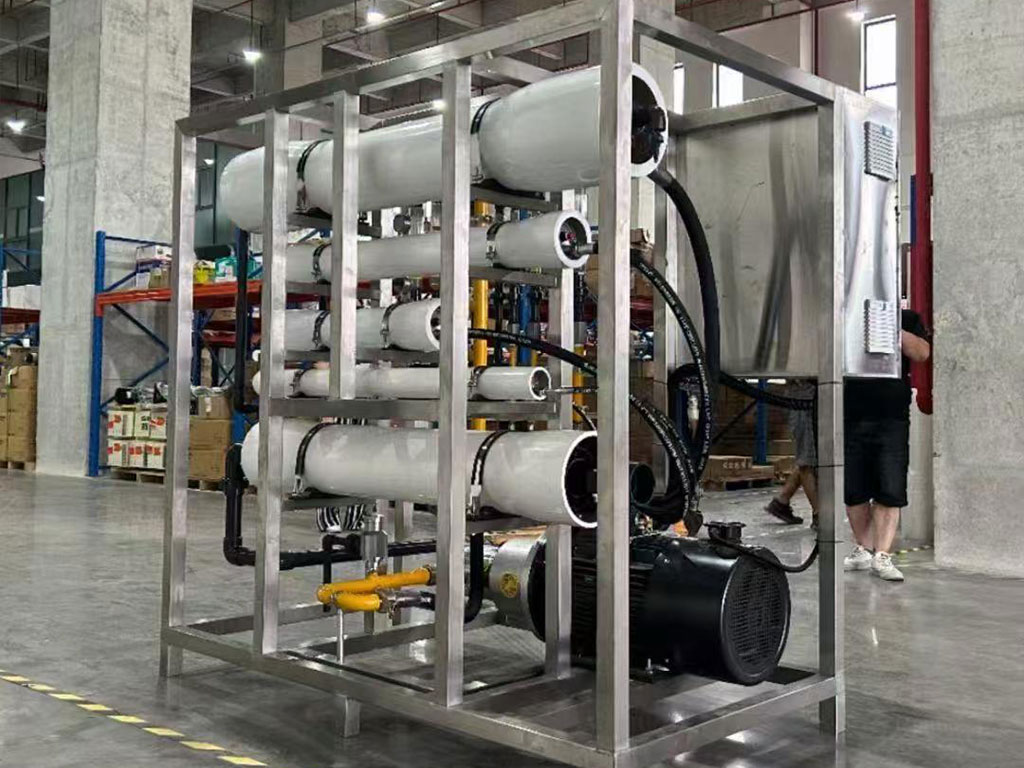
SWRO membrane stack: using specialized high desalination rate membrane elements for seawater desalination (such as SWC4B, SW30HRE). The membrane shell is arranged in stages, with each pressure vessel containing 6-8 membrane elements.
Operation: High pressure seawater flows over the membrane surface, pure water passes through the membrane wall to become product water, and salt is intercepted to form concentrated saltwater. The system recovery rate is controlled at around 40% to prevent supersaturation and scaling of insoluble salts such as CaSO4 and CaCO3.
- Post treatment and tempering
PH adjustment: SWRO produces water that is weakly acidic and corrosive. Dissolved CO ₂ needs to be removed through a degassing tower, or alkaline solutions such as NaOH need to be added to increase the pH value to 7.5-8.5, in order to stabilize its chemical properties, meet drinking water standards, and prevent corrosion of subsequent pipelines.
Disinfection: Ultraviolet (UV) disinfection is used as the main disinfection method, or trace amounts of chlorine (such as sodium hypochlorite) are maintained in the pipeline network to maintain continuous sterilization ability.
3.0 Key Equipment and Design Parameters
4.0 Scheme Characteristics and Brief Economic Analysis
- Technical features:
Efficient and energy-saving: The application of PX energy recovery technology is the core of reducing energy consumption.
Modular and compact design: The main equipment can be integrated on the pry block, with a small footprint and quick installation.
High adaptability: suitable for independent water supply scenarios such as remote areas and islands.
High degree of automation: capable of unmanned operation and remote monitoring.
- Brief economy (estimated based on a water production of 200 m ³/day):
Energy consumption per ton of water: 3.5-4.5 kWh/m ³
Chemical cost: 0.5-1.0 yuan/m ³
Membrane replacement cost (based on 5-year lifespan): 1.0-1.5 yuan/m ³
Maintenance cost: 0.5-1.0 yuan/m ³
Total operating cost per ton of water (excluding depreciation): 5.5-8.0 yuan/m ³